Gathers and analyses
Gathers the person's information and analyses their situation.
Initiative connected to AGAMI
An informational and preparatory tool for legal migration pathways to Italy, starting from the Morocco-Italy corridor.
AGAMI initiative
Discover the project, take part in the round table or contact AGAMI.
What it is
LegalitalEntry was created to transform the complexity of migration procedures into clear, verifiable and documented pathways, reducing errors, incomplete applications and irregular entries. It is a digital platform specialised in supporting foreign nationals who wish to enter, reside or settle legally in Italy.
It does not replace lawyers, CAF centres or patronage offices: it works alongside them, helping people understand the correct pathway, gather the necessary documents and arrive prepared before the professional, with an organised dossier and an initial assessment of their position.
The first version is dedicated to the Morocco-Italy corridor and covers family reunification, subordinate employment and study. It is conceived, however, as an infrastructure for legal mobility within the Euro-Mediterranean-African corridor: immigration is merely the first area of application.
Why it was created
LegalitalEntry stems from experience gained over more than fifteen years of professional activity between Italy and Morocco. Over these years, thousands of people have been assisted who, despite being entitled to enter or reside in Italy, found themselves disoriented in the face of complex procedures, fragmented information and pathways that were difficult to understand.
The project does not arise from an abstract intuition, but from a need observed every day: it is this origin — made up of real cases, real people and real difficulties — that gives it its direction.
What is still missing is a tool that translates the law into clear and workable pathways: it is this gap that LegalitalEntry intends to fill.
The problem
Information is scattered across ministries, embassies, consulates, patronato bodies, social media groups and word of mouth. It is difficult to understand the correct procedure, the documents and the requirements, and to assess the real likelihood of success.
The solution
Gathers the person's information and analyses their situation.
Identifies the most suitable pathway and lists the necessary documents.
Creates an organised dossier and enables its submission to a professional.
Positioning
Defining the limits of the project is as important as describing its functions: it is a choice that protects both individuals and professionals.
Innovative element
Most systems check only the requirements demanded in Italy. LegalitalEntry assesses two dimensions together, for a more realistic preparation of the pathway.
Considering both dimensions brings the assessment closer to the reasoning of those who decide the application, where the person's ties to the country of origin also carry weight.
The core of the system
It reads the user's answers, compares them with the regulatory requirements, identifies the procedures compatible with their situation and automatically generates the list of necessary documents.
An organised representation of laws, procedures, documents, requirements, exceptions and practices, and of the relationships that link them: a body of knowledge kept up to date over time that requires legal expertise.
Procedures covered (MVP)
How it works
Who it is designed for
Italian, Arabic and French, in line with the Morocco-Italy corridor.
Multilingualism concerns not only the interface, but also the documents, conceived as a basic requirement and not as a subsequent refinement.
The role of AGAMI
AGAMI supports LegalitalEntry as a regulatory observatory and research centre on legal mobility between Italy and Morocco.
Studies and analyses on legal migration pathways and on immigration law.
Ongoing monitoring of laws, practices and Euro-Mediterranean cooperation.
Internships, training programmes and collaborations with universities and research centres.
Reports, policy papers and institutional content in support of the project.
Social dimension
Orderly and informed access to the procedures provided for by the law.
Reducing recourse to irregular pathways, often chosen for lack of clear alternatives.
Those who arrive with a regular and well-understood status start from a condition of greater stability.
Legal mobility channels of shared interest between countries of origin and destination.
Development over time
Gradual and verifiable growth, always on the same infrastructure: the model is validated on one corridor, then extended to other countries and procedures.
In the long term, to build the leading digital and scientific ecosystem dedicated to legal mobility between Europe, the Mediterranean and Africa, connecting citizens, professionals, universities, businesses and institutions.
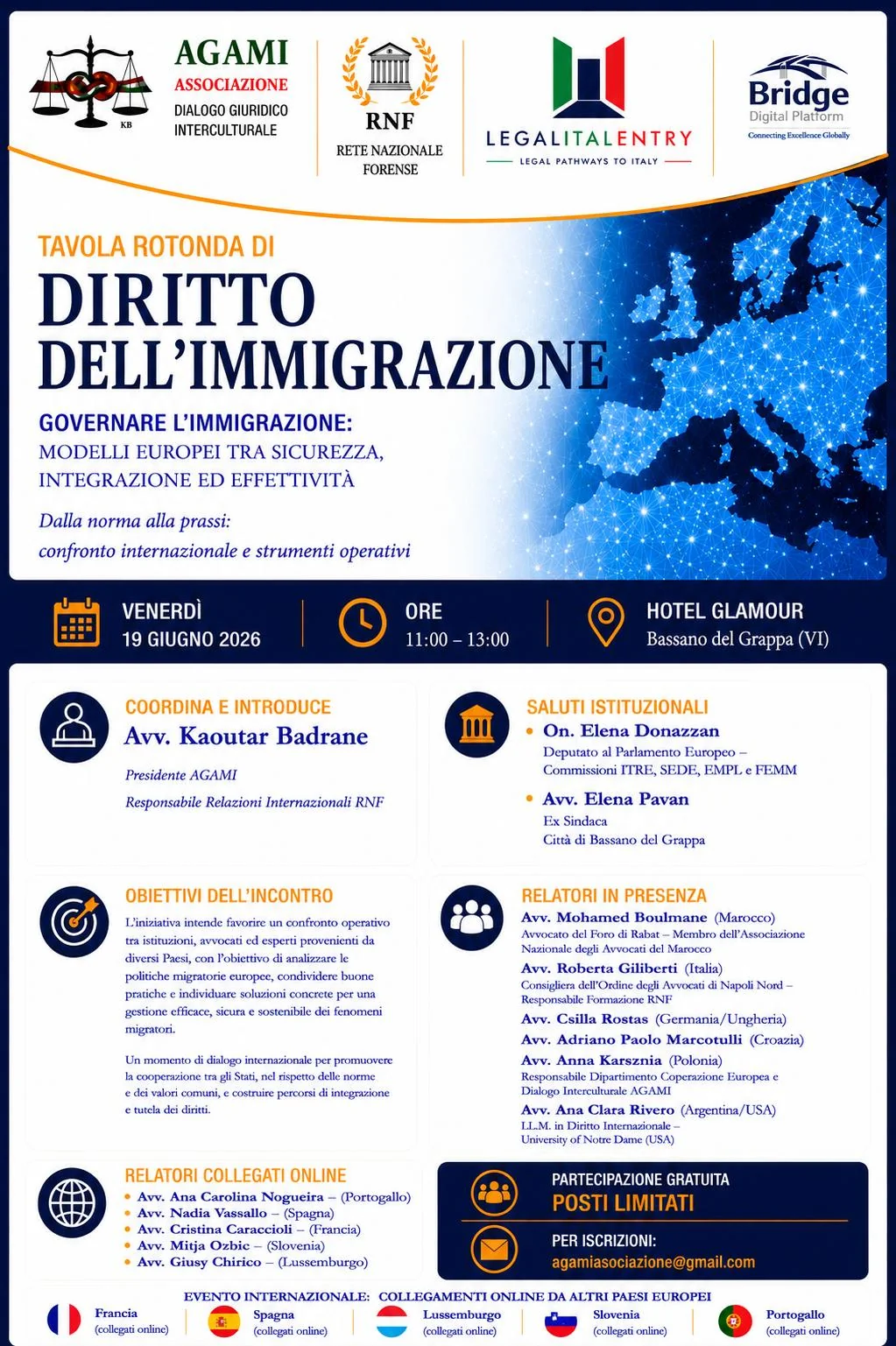
Presentation event
Legal dialogue between Italy, Morocco and Europe, in the service of people and of access to rights.